
With an All Blacks test on Sunday, and only a couple of registered attendees, the leader wisely teamed up with Waimea Tramping Club who had organised the exact same tramp for the previous day. And so it was, on the Saturday morning, 11 persons pooled cars up to the Brook camp, then started walking up the Eureka Track to the skid site. A serious grunt up a steep gravel 4WD road joined the Dun Mountain Railway at the junction known as Four Corners.
Ray stopped at the former site of Second House, one of four maintenance depots. Along the way we saw a dozen wooden railway sleepers protruding from the hardened old track, some of the 24,000 that made up the old horse-drawn tramline which carted chromite from Coppermine Saddle in the 1860s.
Morning tea was drunk at Third House, the site of two-storey stables. Because Atmore’s whare had burned down in 1935, the ‘Atmore Memorial Shelter’ was constructed in 1956-9 by NTC members who spent 23 days on the project. Being a skilled stonemason, our president Laurie Gibbs built the fireplace and chimney. (Today’s Third House shelter was constructed by the Council in the 1970s.)
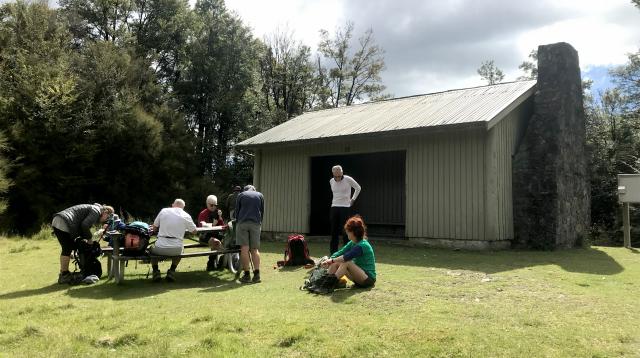 Combined club trip at Third House
A couple of decades ago Californian Dan McGuire invented new ways to climb Wooded Peak. He collected routes up it like some trampers bag huts. Dan did not need a map; he had the back of his hand. Fast forward to 2025 when the Council have erected myriad signposts and historical sign boards along the trail.
We raced on up to Junction Saddle, once the site of a prospectors hut. From here we followed the rough track up to ‘Woody’ (as our club once affectionately named the mountain.) After a gradual introduction, the abrupt climb began, requiring concentration to select solid foot placements and handholds. The stunted beech and horopito were lined with lush green moss but our focus was on negotiating a staircase of thin limestone slabs which towered above. Thankfully, each section of hand-over-hand scrambling was followed by easier terrain to allow us to catch our breath.
Ray was delighted to discover a dozen rusted jam tin lids which 23 NTC trampers had nailed to trees in June 1935 on a ‘discing trip.’ An assortment of white permolat markers from the Forestry Service era complimented the orange DOC triangles.
So far we’d been blessed by balmy sunshine. Suddenly, the temperature dropped like an Aussie scrum and a hailstorm hit from nowhere. It lasted a few moments, but by then we had wrapped up in warm layers. After an age we topped out on the Peak. What did we see? Wood, actually. We ate lunch here in dappled sunshine under a canopy of scrappy forest below the trig pole.
To descend Woody, our company followed the track our club had cut along Wells Ridge in 1941. Halfway down we emerged out of the woods into the ultramafic zone where we drank in glorious views of the distant Richmond Range.
Windy Point lived up to its name, so we returned to Nelson on the Dun line where we stumbled over many more railway sleepers. At the bush edge a waterfall plummeted into Coads Creek on its way to the Roding River. This was where NTC advance parties would light a fire to boil the billy. A little further on was the site of Fourth House where NTC stalwarts once recorded current weather conditions in a hard-backed book at the weather station, a white box on stilts.
 Shane, Ray & Andrea at Windy Point
Lighting fires is probably prohibited nowadays, so we sipped thermos tea back at Third House. The interminable tramline was rocky underfoot, so after travelling for more than eight hours, we were happy to return to Brook Street.
Thank you to David Wheeler from WTC for leading the way, and shepherding the stragglers.
Walking Time: 8 hours; Distance: 25km; Elevation Gain: 1000m.
Wooded Peak-baggers: Ray Salisbury (scribe & co-leader) plus Andrea and Shane.